
Import & Export shipping containers are used to move the Import & Export cargo ‘s on the container ships .
The containers are essential to the efficient cargo flow of all Import & Export cargo movements.
To alleviate the late return of Containers, detention charges are imposed by the shipping lines for the containers not returned to the designated return location within the allowed free time period.
The “free time” begins from the first day the container is made available on the wharf. This is often a source of contention and some Importers may think that the “free time” commences when they collect the container.
Shipping containers have revolutionized the way cargo is transported on ships the across oceans. Containerization has not only helped in ensuring the safety of the cargo transits but has also improved the overall cargo carrying capacity of the cargo ships.
Until 1956 goods packed in bales, sacks or barrels were individually transferred from the delivery vehicle to the waiting cargo ship. This was manual work carried out by “longshoremen” using pulleys, cargo hooks and a significant labour force. An average ship had 200, 000 individual pieces of cargo and it would take around a week to load and unload.
The shipping container has only been around for the last 50 years. The containerization of cargo revolutionized the transportation of goods as, thefts, damage to goods and costs were drastically reduced.
This ultimately revolutionized international trade & vastly increased cargo turnaround times
Mostly, all shipping containers are made from steel and have closed-top with hinged doors they are a standardized reusable steel box, used to store and move materials and products ,in international trade
Inter-modal shipping is a method of moving cargo that involves more than one kind of transportation, whether truck, rail, ship or plane. By using standard shipping containers your cargo is transferred from ship to rail to truck without having to be repacked This allows moving your containerised cargo between truck to ship to warehouse with ease.
we will then combined your cargo with other shipping consignments headed for the same destination.
Should you require more specialised container equipment or if you have any further questions ,please contact us.
| 20′ GP Container Dimensions | Millimetres | Feet | |
| Inside Dimensions | Length | 5885 | 19’4” |
| Width | 2350 | 7’8” | |
| Height | 2403 | 7’10” | |
| Door Opening | Width | 2338 | 7’8” |
| Height | 2292 | 7’6” | |
| Kilograms | Pounds | ||
| Weight | Max. Gross | 24000 | 52910 |
| Tare | 2150 | 4740 | |
| Max. Payload | 21850 | 48170 | |
| Cube Metres | Cube Feet | ||
| Capacity | 33,150 | 1170 | |
| 40′ GP Container Dimensions | Millimetres | Feet | |
| Inside Dimensions | Length | 12033 | 39’6” |
| Width | 2350 | 7’8” | |
| Height | 2394 | 7’10” | |
| Door Opening | Width | 2338 | 7’8” |
| Height | 2280 | 7’6” | |
| Kilograms | Pounds | ||
| Weight | Max. Gross | 30480 | 67200 |
| Tare | 3800 | 8377 | |
| Max. Payload | 26680 | 58823 | |
| Cube Metres | Cube Feet | ||
| Capacity | 67,7 | 2390 | |
| 40′ GP High Cubic Container Dimensions | Millimetres | Feet | |
| Inside Dimensions | Length | 12024 | 39’6” |
| Width | 2350 | 7’8” | |
| Height | 2697 | 8’10” | |
| Door Opening | Width | 2340 | 7’8” |
| Height | 2597 | 8’6” | |
| Kilograms | Pounds | ||
| Weight | Max. Gross | 30480 | 67200 |
| Tare | 4020 | 8860 | |
| Max. Payload | 26460 | 58340 | |
| Cube Metres | Cube Feet | ||
| Capacity | 76,3 | 2694 | |
If you are new to shipping terms contracts you may be unaware of the different trading practices in their respective countries. A small misunderstanding with the shipping terms could lead to disputes over who was meant to pay for the overseas freight, insurance or other costs involved in the shipment of goods.
The shipping trade rules or International Commercial Terms ( Inco terms) are a series of defined commercial terms published by the International Chamber of Commerce(ICC).
They are widely used in the International trade processes. They are series of three-letter trade terms related to the common contractual sales practices. The Incoterms rules are intended primarily to clearly communicate the tasks, costs, and risks associated with the transportation and delivery of goods.
The rules are accepted by governments, legal authorities, and practitioners worldwide for the interpretation of most commonly used terms in international trade. They are intended to reduce or remove altogether uncertainties arising from different interpretation of the rules in different countries. As such they are regularly incorporated into sales contracts worldwide.
First published in 1936, the Incoterms rules have been periodically updated, with the eighth version “Incoterms 2010” having been published on January 1, 2011.
These terms are used to help eliminate the uncertainties in the different interpretations of such trade terms in language and different countries. To avoid confusion the International Chamber of Commerce published (1936) a set of international rules for standard trade terms known as Incoterms. Since 1936 regular amendments and updates (1953, 1967, 1976, 1980, 1990, 2000 and 2010) have been made to keep all practices and terms current.
In some jurisdictions, the duty costs of the goods may be calculated against a specific Incoterm (for example in India, duty is calculated against the CIF value of the goods and in South Africa the duty is calculated against the FOB value of the goods.
Because of this it is common for contracts for exports to these countries to use these Incoterms, even when they are not suitable for the chosen mode of transport. If this is the case then great care must be exercised to ensure that the points at which costs and risks pass are clarified with the customer. Rules for any mode of transport[
EXW means that a buyer incurs the risks for bringing the goods to their final destination. Either the seller does not load the goods on collecting vehicles and does not clear them for export, or if the seller does load the goods, he does so at buyer’s risk and cost. If the parties agree that the seller should be responsible for the loading of the goods on departure and to bear the risk and all costs of such loading, this must be made clear by adding explicit wording to this effect in the contract of sale.|
There is no obligation for the seller to make a contract of carriage, but there is also no obligation for the buyer to arrange one either – the buyer may sell the goods on to their own customer for collection from the original seller’s warehouse.
However, in common practice the buyer arranges the collection of the freight from the designated location, and is responsible for clearing the goods through Customs. The buyer is also responsible for completing all the export documentation, although the seller does have an obligation to obtain information and documents at the buyer’s request and cost.
These documentary requirements may result in two principal issues. Firstly, the stipulation for the buyer to complete the export declaration can be an issue in certain jurisdictions (not least the European Union) where the customs regulations require the declarant to be either an individual or corporation resident within the jurisdiction.
If the buyer is based outside of the customs jurisdiction they will be unable to clear the goods for export, meaning that the goods may be declared in the name of the seller, in breach of the EXW term.
Secondly, most jurisdictions require companies to provide proof of export for tax purposes. In an EXW shipment, the buyer is under no obligation to provide such proof to the seller, or indeed to even export the goods. In a customs jurisdiction such as the European Union, this would leave the seller liable to a sales tax bill as if the goods were sold to a domestic customer.
If delivery occurs at the seller’s premises, or at any other location that is under the seller’s control, the seller is responsible for loading the goods on to the buyer’s carrier. However, if delivery occurs at any other place, the seller is deemed to have delivered the goods once their transport has arrived at the named place; the buyer is responsible for both unloading the goods and loading them onto their own carrier.
CPT replaces the C&F (cost and freight) and CFR terms for all shipping modes outside of non-containerized seafreight. The seller pays for the carriage of the goods up to the named place of destination. However, the goods are considered to be delivered when the goods have been handed over to the first or main carrier, so that the risk transfers to buyer upon handing goods over to that carrier at the place of shipment in the country of Export.
If the buyer requires the seller to obtain insurance, the Incoterm CIP should be considered instead.
This Incoterm requires that the seller delivers the goods, unloaded, at the named terminal. The seller covers all the costs of transport (export fees, carriage, unloading from main carrier at destination port and destination port charges) and assumes all risk until arrival at the destination port or terminal.
All charges after unloading (for example, Import duty, taxes, customs and on-carriage) are to be borne by buyer. However, it is important to note that any delay or demurrage charges at the terminal will generally be for the seller’s account.
Incoterms 2010 defines DAP as ‘Delivered at Place’ – the seller delivers when the goods are placed at the disposal of the buyer on the arriving means of transport ready for unloading at the named place of destination. Under DAP terms, the risk passes from seller to buyer from the point of destination mentioned in the contract of delivery.
Once goods are ready for shipment, the necessary packing is carried out by the seller at his own cost, so that the goods reach their final destination safely. All necessary legal formalities in the exporting country are completed by the seller at his own cost and risk to clear the goods for export.
Under DAP terms, all carriage expenses with any terminal expenses are paid by seller up to the agreed destination point. The necessary unloading cost at final destination has to be borne by buyer under DAP terms.
Seller is responsible for delivering the goods to the named place in the country of the buyer, and pays all costs in bringing the goods to the destination including import duties and taxes. The seller is not responsible for unloading. This term is often used in place of the non-Incoterm “Free In Store (FIS)”.This term places the maximum obligations on the seller and minimum obligations on the buyer. No risk or responsibility is transferred to the buyer until delivery of the goods at the named place of destination.
Also of note is that the point at which risk passes under these terms has shifted from previous editions of Incoterms, where the risk passed at the ship’s rail.
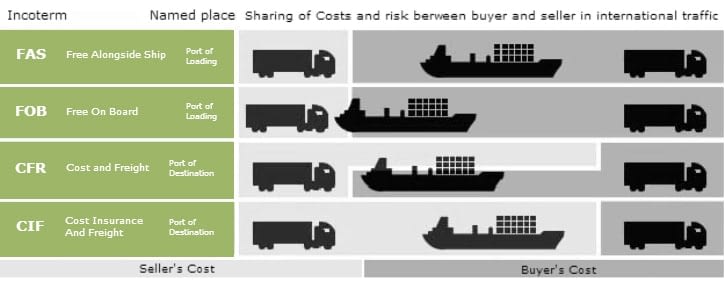
The seller delivers when the goods are placed alongside the buyer’s vessel at the named port of shipment. This means that the buyer has to bear all costs and risks of loss of or damage to the goods from that moment.
The FAS term requires the seller to clear the goods for export, which is a reversal from previous Incoterms versions that required the buyer to arrange for export clearance. However, if the parties wish the buyer to clear the goods for export, this should be made clear by adding explicit wording to this effect in the contract of sale. This term should be used only for non-containerized seafreight and inland waterway transport.
Under FOB terms the seller bears all costs and risks up to the point the goods are loaded on board the vessel. The seller must also arrange for export clearance. The buyer pays cost of marine freight transportation, bill of lading fees, insurance, unloading and transportation cost from the arrival port to destination.
Since Incoterms 1980 introduced the FCA incoterm, FOB should only be used for non-containerized seafreight and inland waterway transport. However, FOB is still used for all modes of transport despite the contractual risks that this can introduce.
The seller pays for the carriage of the goods up to the named port of destination. Risk transfers to buyer when the goods have been loaded on board the ship in the country of Export. The Shipper is responsible for origin costs including export clearance and freight costs for carriage to named port. The shipper is not responsible for delivery to the final destination from the port (generally the buyer’s facilities), or for buying insurance.
If the buyer does require the seller to obtain insurance, the Incoterm CIF should be considered. CFR should only be used for non-containerized seafreight and inland waterway transport; for all other modes of transport it should be replaced with CPT.
CIF requires the seller to insure the goods for 110% of their value under at least the minimum cover of the Institute Cargo Clauses of the Institute of London Underwriters (which would be Institute Cargo Clauses (C)), or any similar set of clauses.